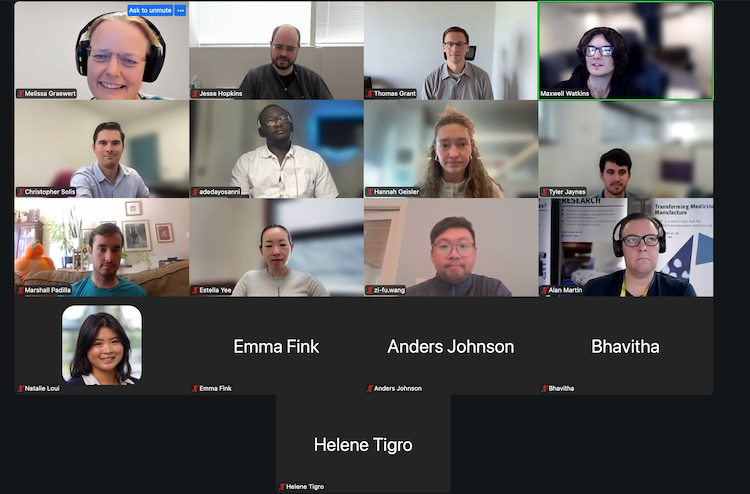
BioCAT held its tenth BioSAXS training course from 10/7/25-10/10/25. There were 35 remote participants and 8 instructors. The workshop was held entirely online, via Zoom, for ~5 hours each day.
Day one started off with an excellent overview of the basic physics of SAXS and what kind of information you can obtain from the technique by Dr. Thomas Weiss (BL4-2 beamline, SSRL). This was followed by a talk from Dr. Jesse Hopkins (BioCAT) on the basics of SAXS instrumentation and different types of SAXS experiments. Following that Dr. Hopkins gave a lecture covering the details on what a scattering profile is and basic SAXS data analysis and validation. Then the workshop broke into smaller groups, and students spent several hours working through detailed self-guided tutorials that took them through basic SAXS data processing and validation. Each small group had an expert available to answer any questions that came up. Participants then returned to the large group and the first day ended with a Q&A with Drs. Weiss, Hopkins, and Dr. Max Watkins (BioCAT) and the participants.
Day two started with a lecture from Dr. Kushol Gupta (Penn. State) covering extremely important and sometimes overlooked steps of how to actually plan and perform SAXS experiments. He covered everything from planning what data you want to collect to sample preparation for the experiment, to complementary biophysical techniques for verifying your results. Then Dr. Estella Yee (MacCHESS, CHESS) gave a talk on SEC-SAXS, describing what it is, why it’s useful, how to analyze the data, common issues, and some advanced analysis methods. The rest of the day was spent in the small groups working on a tutorial covering SEC-SAXS data analysis.
Day three started with a talk by Dr. Tom Grant (U. Buffalo) about calculating theoretical SAXS profiles from models and reconstructing 3D models from SAXS data. Dr. Watkins then gave a talk on best practices for publishing SAXS data. This was followed by a talk from Dr. Melissa Graewert (P12 beamline, EMBL Hamburg) on the how coupled asymmetric flow field-flow fractionation (AF4) can be coupled to SAXS, a separation technique that is now available BioCAT. The rest of the day was spent in small groups doing a tutorial on 3D reconstructions and calculating theoretical SAXS profiles from models.
Day four started with a series of lectures on advanced applications and analysis of SAXS data. Dr. Michal Hammel (SIBYLS beamline, ALS) gave a talk about using their SAXS and MD coupled analysis tools, particularly BilboMD, and new advancements in incorporating predicted structures from AlphaFold. Dr. Watkins then gave a lecture introducing the principles and practice of rigid body modeling with SAXS data. Then Dr. Hopkins started with a talk about analyzing flexible and disordered systems using SAXS, with a particular focus on ensemble analysis methods. Finally, Dr. Hopkins gave a lecture on time resolved SAXS and how and what you can do with the technique at BioCAT. The workshop finished with a brief lecture from Dr. Hopkins on the practical steps to apply for beamtime at BioCAT, and a large group Q&A with Drs. Hopkins and Watkins.